
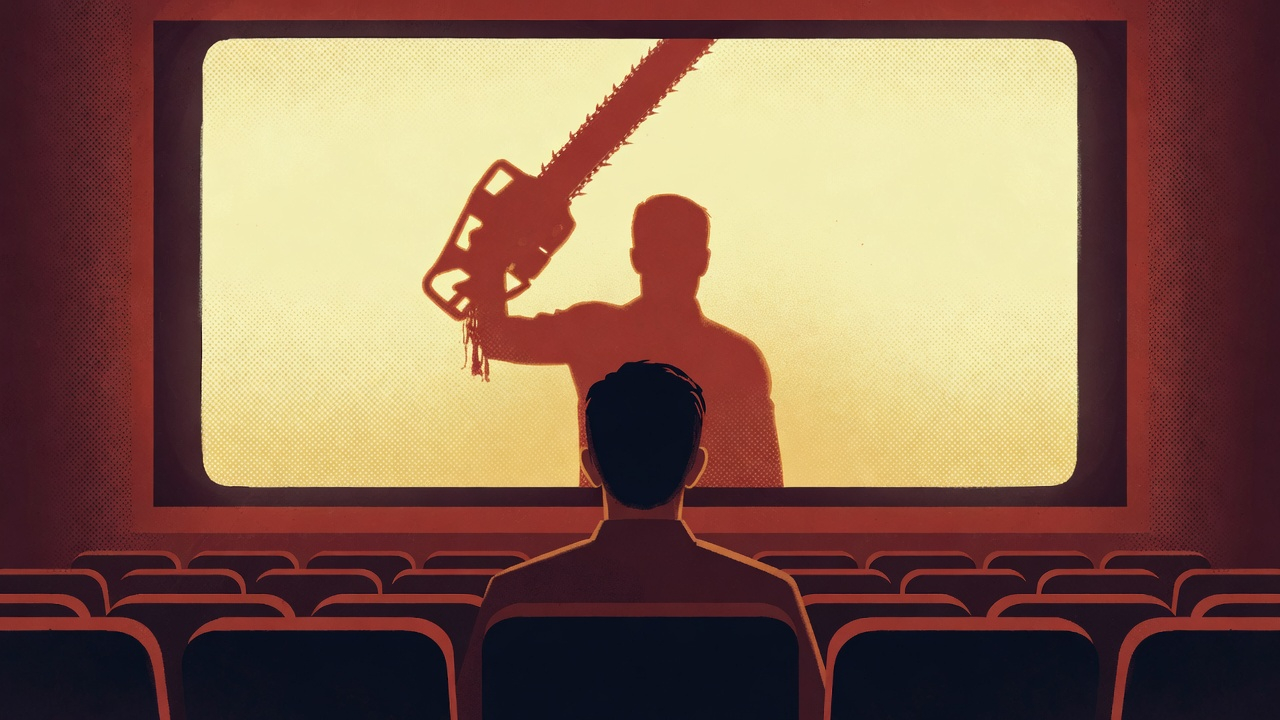
My husband, Chris, knows all about Bruce Campbell and my fixation on him. So this post is less of a confession than it is an explanation for anyone who hasn’t had to hear about it for the past however many years.
I was twelve years old and most assuredly not supposed to be watching Evil Dead II, and all six feet of Bruce Campbell looking like a piece of chocolate with a chainsaw in place of a hand. My still-forming brain imprinted onto this in ways I did not fully understand at the time but which, in retrospect, explains quite a lot. Ash Williams was as ridiculous as he was fearless, and the actor playing him seemed to be in on the joke without it ever undermining his charm.
In case you can’t tell, I’ve been a devoted Evil Dead fan since… well, forever. I was there through Army of Darkness and the criminally underappreciated Ash vs Evil Dead series, along with every campy B-movie that Campbell has delivered over a forty-year career. His work has always had nothing but my deep admiration.
There is an affection you develop for the artists who shaped you when you were still figuring things out. Campbell was part of that for me. Not the loudest part, but a part. He was this larger-than-life figure who made horror feel like fun and made fun feel like an art form. Seeing the pop-up on my iPhone when he has announced a cancer diagnosis hit in a way I felt I had no right to feel.
First off, the announcement itself was too brief. He posted to social media to say he had a diagnosis—treatable but not curable—that the details were private, and we should fear not. The last part is so purely Bruce that I almost smiled before I remembered why I was reading it.
This keeps happening. Why does this keep happening?
That’s the thought that won’t go away once the initial jolt of the thing passes. As I’m on the sunny side of fifty, I have started to notice a pattern in things rather than just the endless series of shocks. Harrison Ford turned eighty-two this year, so I find myself checking up on him with a regularity that would embarrass me if I thought about it too much. The people who were there for my formative years, such as Sam Neill, keep surfacing with these diagnoses, and each one comes with a weight that does not mesh with my relationship to them. I have never met Bruce Campbell. He does not know I exist. Still, that doesn’t soften the blow of his news.
There is a grief that attaches to the idea of someone, or to what they represented at a specific time in your life, that does not need closeness to be real. I feel it. I know everyone in Campbell’s immediate orbit is sitting with something far closer to it right now, and is exactly why what he chose to share matters as much as it does.
Which brings me to the part I am less proud of.
I hate it. That’s my honest version, and I am going to say it before I walk it back, because the walk back is coming and it needs to land on top of something real. The “details private” part of Campbell’s announcement is a loss. Not a personal loss but a public health one, and watching it happen again with someone I admire made me want to put my fist through a wall.
Case in point: Catherine, the Princess of Wales, spent most of early 2024 out of the public eye after her abdominal surgery, and the resulting media brouhaha was quite ugly—the conspiracy theories alone made me want to gag. When she finally released a video in March confirming it was cancer, she explained that she had needed time to process it herself and to find the right words for her children before she could get to the right words for everyone else. Some of us responded with frustration anyway. We said she had waited too long and that the public deserved to know sooner.
Yup. I was one of them.
The other issue that keeps gonging around in my head is Bruce Willis. When his family announced his aphasia diagnosis in 2022 and then updated it to frontotemporal dementia in 2023, they were intentional about what they said and when they said it. FTD is a disease that most people didn’t know existed before this announcement, and suddenly it was real and wore a public face. Donations to research organizations increased. Neurologists reported patients coming in because they had read about Willis and saw something in their own family members or even themselves.
Watching disclosure work this way for FTD awareness, and then seeing someone with a comparable disease keep the details to themselves, makes one do the math and then have to sit with the loss of what good things might have followed. Campbell has legions of fans who would listen to him. Whatever he has, he could move the needle on it. Every time someone with that much influence goes quiet, there are people who will never make an appointment or ask their doctor a question or connect a symptom to a name because no one with a face they knew ever told them to. That is what I hate. Not him. The loss of the opportunity.
Then I think about what it means to receive a cancer diagnosis, and my frustration becomes harder to justify.
Typically, a cancer diagnosis arrives before the staging, or any conversation about what next year, or even months, will look like. Campbell made his announcement from within that window to tell millions of followers he was sick. He wasn’t withholding, but buying time that was rightfully his.
Princess Catherine needed to tell her children before she told the world. I doubt this was part of a media strategy. The fact that her timeline conflicted with the press’s appetite for information is not a failure on her part.
Fame is not a contract that signs away your rights to your own body. A diagnosis does not become a public health resource simply because the person receiving it has a large following. Keeping your information private is a right that needs no asterisk. Sharing openly deserves gratitude, not the burden of having that generosity get distorted into a standard everyone else gets measured against.
Being sick comes first. The public figure part can wait, and that order is not a luxury but a dignity any person is owed.
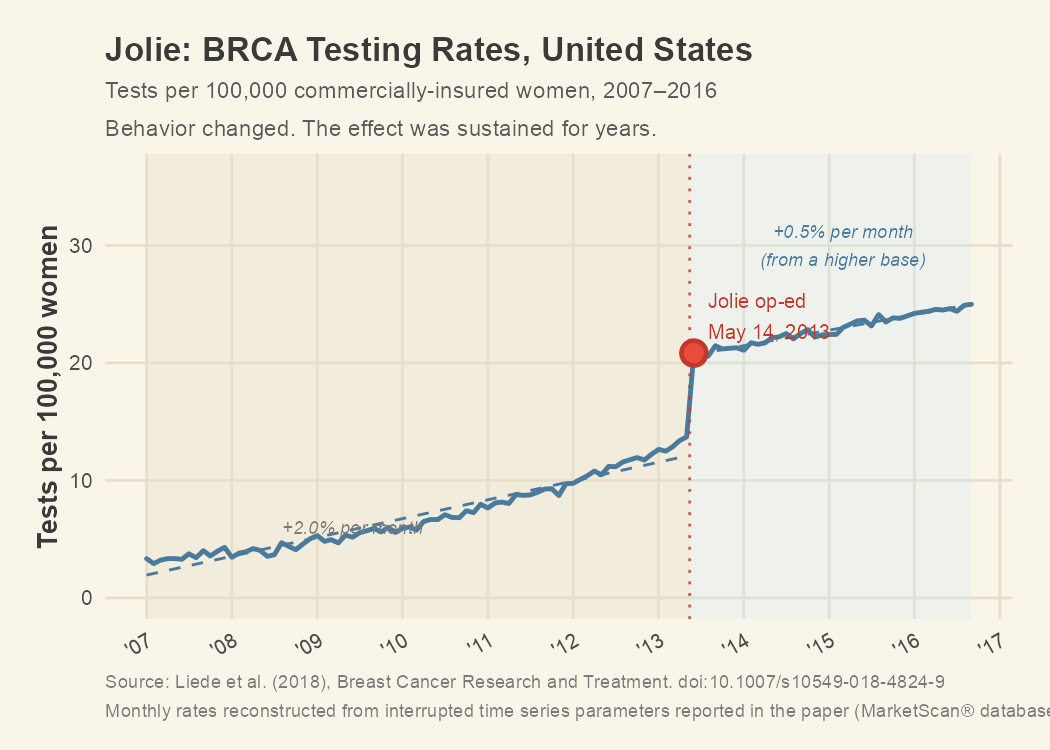
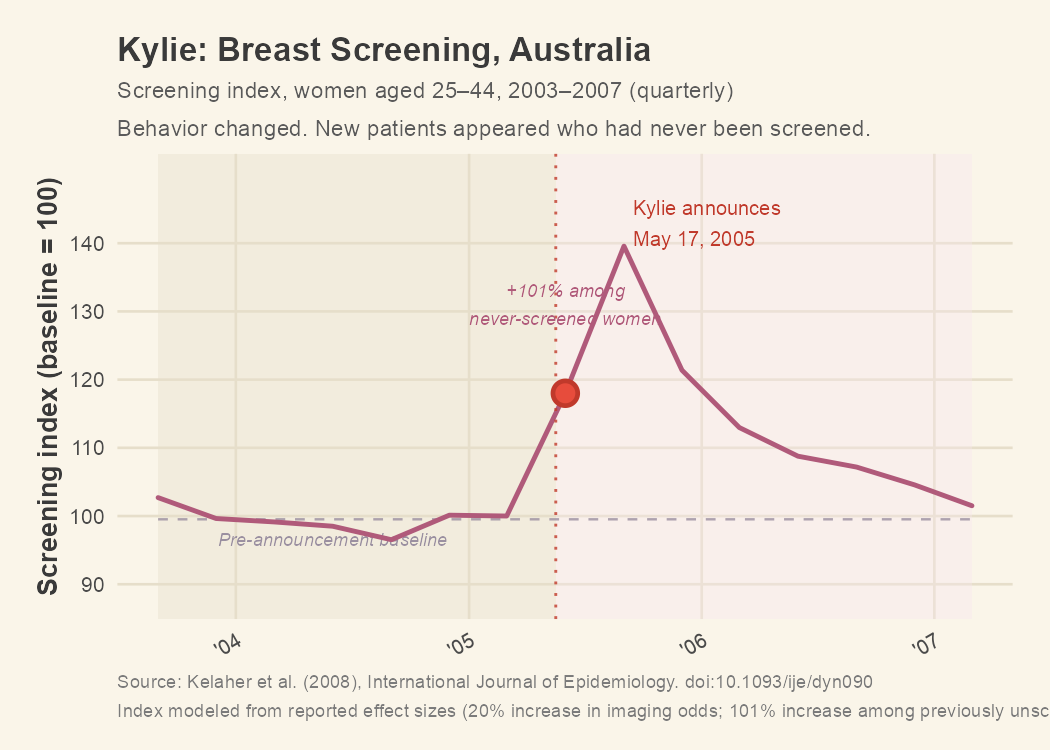
There is a public health argument for celebrity disclosure, and it does deserve more than a sniff at. Angelina Jolie’s 2013 New York Times op-ed about her BRCA testing and preventive mastectomy was followed by a sustained increase in genetic testing and risk-reducing mastectomy rates across the commercially-insured US population. BRCA testing jumped from 16 to nearly 21 tests per 100,000 women in a single month and held for years. Kylie Minogue’s 2005 breast cancer announcement produced what researchers dubbed the “Kylie effect,” a rapid rise in mammogram bookings among Australian women aged 25 to 44, with previously unscreened women attending at twice the prior rate.
These are not awareness numbers, but behavior numbers. They mean people made appointments and had procedures. What the celebrity provided was permission, or maybe just a face the audience already had feelings about.
[Chart: Jolie — BRCA testing rates, United States, 2007–2016]
[Chart: Kylie — Breast screening index, Australia, 2003–2007]
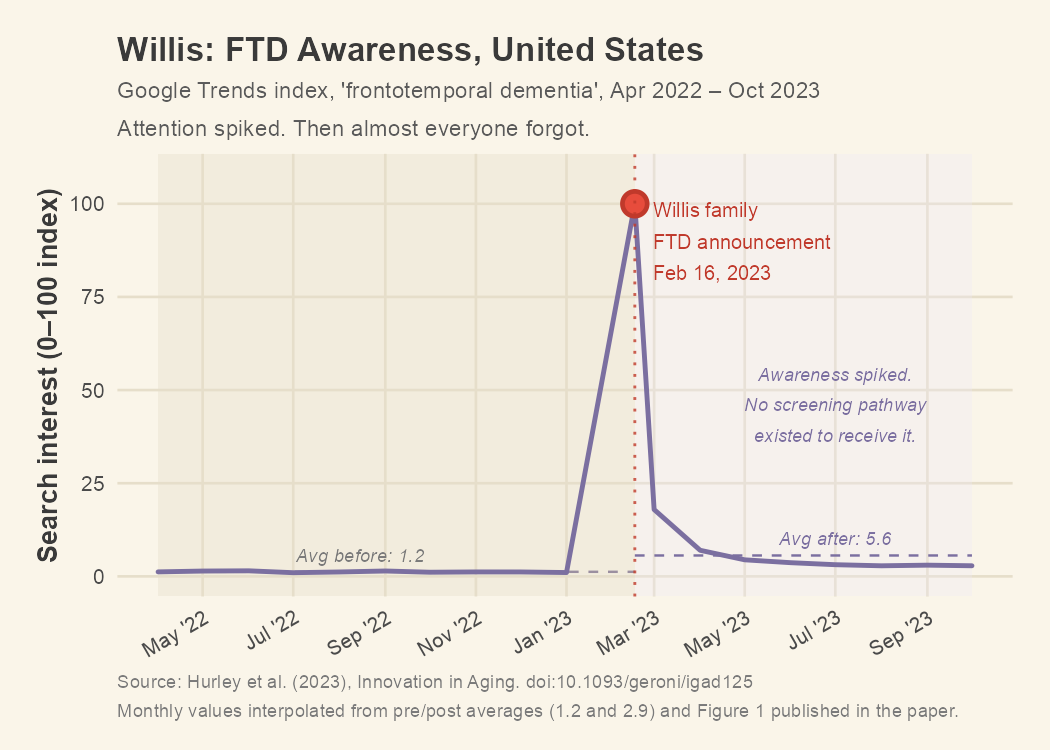
Willis is a different part of the story. Google Trends data shows search interest for frontotemporal dementia spiking from near zero to its maximum in the week of the announcement before falling back to almost nothing within a few months. The awareness was real, and so was how fast it faded.
[Chart: Willis — FTD search interest, United States, 2022–2023]
The difference in Willis’s chart is because of what was waiting on the other side of that attention. Jolie’s op-ed came while there was a system that already had BRCA testing infrastructure in place. Kylie’s landed in a country with an established breast screening program. When Willis’s family said “FTD,” people searched, found that there was nothing clinical to do with that information, and closed their laptops. The system had no way to catch the attention.
Public health campaigns are impersonal on purpose because they need to have scalability. A PSA strips away every individual detail until only the general message is left behind. A celebrity disclosure does the opposite, instead arriving attached to a person the audience already has feelings about, and that weight gives their information a gravity no poster campaign can do on its own.
We do not know what Campbell has. Everything else is speculation, but that’s not the point. Whatever he has, the same logic applies. If his diagnosis maps onto an existing screening program or a genetic test most people could ask their doctor about, disclosure could move real behavior. If it doesn’t, the attention spikes and fades, and everyone who got frustrated at him for staying quiet would have nothing to show for it.
Campbell knows which situation he is in. The rest of us are standing outside asking him to open a door without knowing whether it leads anywhere, and that is exactly why the demand for disclosure is so hard to defend.
We built a public health communication system so dependent on celebrity attention that it often underperforms without it. We then failed to build the clinical infrastructure that would let that attention do anything lasting when it arrives. That is what’s worth being angry about, and it has nothing to do with Bruce Campbell’s privacy.
None of which changes how I feel about Bruce Campbell, the person.
Ash Williams has survived a haunted cabin in the woods, deadites, his own severed hand, multiple trips through time, and a department store full of possessed mannequins, all with his chin out and his ego intact. That made a generation of horror fans fall a little bit in love with him, including at least one gay kid who was twelve years old and had no words yet for exactly what he was feeling but knew, absolutely, that Bruce Campbell was something pretty special.
The man behind Ash is dealing with something that no chainsaw can touch, and he has told us everything we truly only need to hear. He is sick, but he is not gone. We should not be afraid on his behalf. Whatever he chooses to say beyond that will be a gift. This fight is his, on his turf, so can share however, whenever, and whatever he wants.
And, Bruce? If you happen to be reading a nobody’s public health Substack while you recover, I hope you knows the chainsaw hand crowd is pulling for you.
Groovy.
A note on the charts:
The Jolie chart reconstructs monthly BRCA testing incidence rates from interrupted time series parameters reported in Liede et al. (2018), Breast Cancer Research and Treatment, using US insurance claims data from approximately 46 million commercially-insured women.
The Kylie chart models a quarterly screening index from effect sizes reported in Kelaher et al. (2008), International Journal of Epidemiology.
The Willis chart reproduces Google Trends values from pre- and post-disclosure averages published in Hurley et al. (2023), Innovation in Aging.
Reconstructed values are illustrative of the published findings and are labeled as such in each chart caption.
R code for all three charts is available on GitHub.