
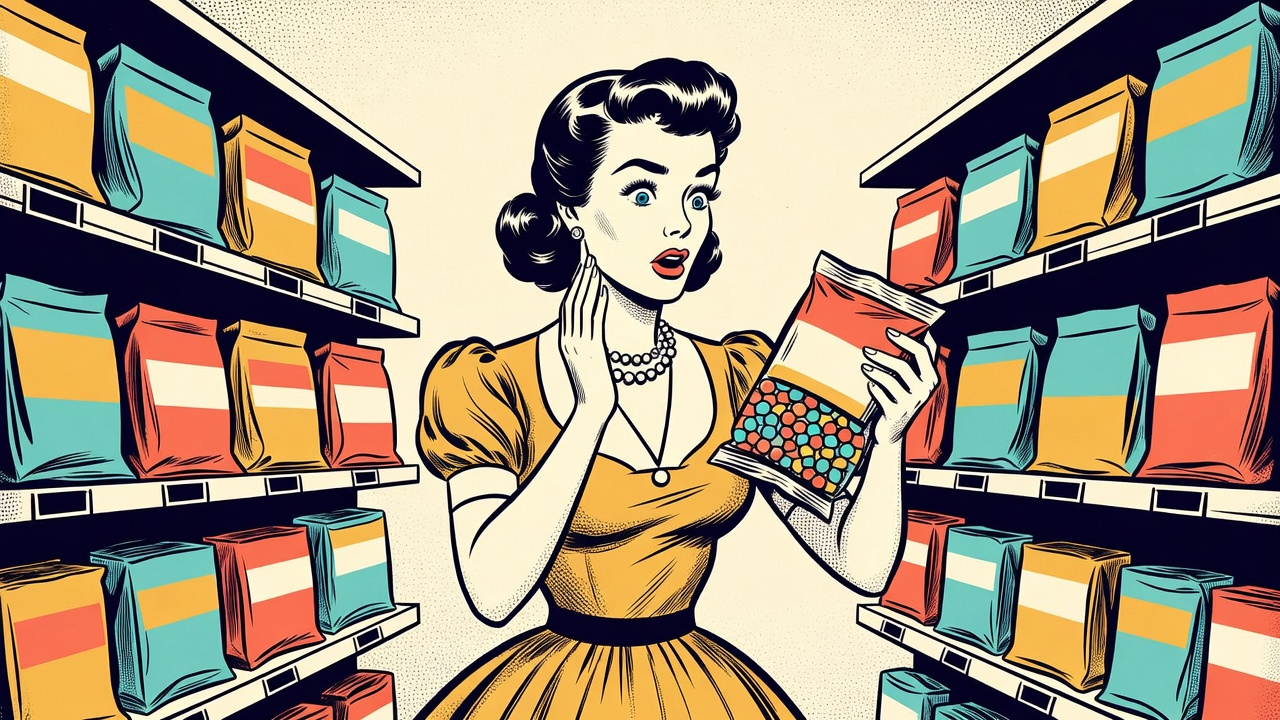
One of the many reasons I have been staying off social media as of late is that it feels less like catching up with people and more like wading through a confidence contest between people who don’t know what the hell they’re talking about.
Last month, a Food Babe meme appeared in my feed with a direst of warnings that Skittles contain titanium dioxide—gasp!—which is linked to DNA damage, and the sensible people over in Europe banned the stuff because it was oh, so bad for you. Supposedly, this constitutes undeniable proof that all the American food companies are intentionally poisoning their customers while they sell safer products abroad. Needless to say, her post was shared by her followers tens of thousands of times.
Yes, the EU ban is real. The European Food Safety Authority concluded in 2021 that genotoxicity could not be ruled out, even though the FDA, Health Canada, and regulators in Australia and the UK reviewed the findings and came to a different conclusion. The science is indeed unsettled on this matter, but the standard rhetoric is to push the most alarming outcome as the complete picture, ignore the countries that disagreed with you, and let the implication do the rest of the work.
Further down popped up another meme, this one all about seed oils. These, including canola and soybean and sunflower, have the distinction of being the villain du jour in online wellness spaces of which Food Babe helped construct. The idea is that these oils drive inflammation and, to put it mildly, are the root cause of chronic disease. Major reviews published through 2025, covering hundreds of thousands of participants across dozens of countries, find the opposite. Linoleic acid, the fatty acid that makes up the majority of most seed oils, is constantly getting lumped in with lower cardiovascular risk. RCT data does not support the inflammation hypothesis at all, and the American Heart Association has warned that reducing omega-6 intake would increase cardiovascular disease.
The panic over seed oils is not contested science, and treating it as such is how Big Wellness gets itself exempt from accountability. Passing along a false claim without knowing that it was false, while having no commercial reason to care otherwise, is not only classic misinformation, but also a sign of someone who has not done their homework. Disinformation, on the other hand, is the deliberate construction of misleading information, and knowing exactly what is being left out. The omissions are not accidents, but load-bearing walls.
Vani Hari, known as the Food Babe, runs one of the most successful wellness fear operations in the country. Most of her critics do not challenge her directly, but settle for just pointing out that she is plain wrong. Unfortunately, that is not enough.
Calling her just “wrong” means the problem is a knowledge deficit, so correcting it would mean correcting the behavior. That lets her off the hook. What she has built is a business model that depends on the ignorance of her audience remaining intact.
Her biggest tell is that she never does updates.
When credible sources have corrected her claims, she just keeps doing what she’s doing. The rhetoric just gets moved to the next post. Factchecking does nothing, because most frightened readers do not know the difference between a hazard and a risk. Not only that, they are not just her audience but her customers.
Intent is difficult to establish standing on the outside looking in. What is not difficult to conclude is that the commercial incentive she, and others like her, makes the fear so important.
FoodBabe.com is not a public health resource with a small shop attached. The blog and the supplement company, Truvani, are two enterprises operating in tandem. The blog and endless reels gets the audience frightened, fear then creates demand for ingredient-free alternatives—which Truvani happens to have several varieties to choose from—and every post warning you about a chemical in your food is a top-of-funnel event for a commercial transaction.
None of that makes her unique amongst those in Big Wellness. What sets her apart is that the fear cannot be corrected without destroying the commercial engine. A food company making misleading health claims about its own products is subject to FTC scrutiny, but a blogger making misleading claims about other companies’ products, which happen to drive traffic to her own store, is in a far less regulated space. The whole shebang is designed to be immune to accountability.
The most important scientific sleight of hand in Hari’s work is the conflation of hazard with risk, which are not interchangeable terms. A hazard is anything capable of causing harm under certain conditions, while risk is the probability of harm at a given level of exposure in a population. Everything is a hazard at some dose—even water!—and what matters is what happens at the doses people encounter in their everyday life.
When IARC classified glyphosate as a “probable carcinogen” in 2015, Hari heralded that as proof that Roundup causes cancer in people who eat food containing trace residues. What IARC is actually doing is hazard identification. They ask whether a substance could cause cancer somewhere and somehow under some conditions, not whether it does at the levels people are normally exposed to. This difference matters. Typical dietary glyphosate residues fall in the range of parts per billion. The occupational exposures that drove IARC’s concern involved agricultural workers with years of repeated direct contact.
The EPA, the European Food Safety Authority, and Health Canada all reviewed the cumulative evidence and concluded that glyphosate at realistic dietary exposures does not pose an unreasonable cancer risk. That is not settled science the way the germ theory of disease is settled, and a small number of independent researchers continue to contest it, but a hard scientific question with a contested regulatory answer is not equivalent to Food Babe’s way of doing things, which is to treat the IARC classification as proof positive and push everything that complicates it under the rug.
Hari’s signature move is to take a familiar substance, label it as a threat through picking and choosing sources, and let the fear do the talking. Her most famous example comes from a 2011 post on airplane travel (since deleted from her site but preserved in cached form) in which she warned that cabin air “is mixed with nitrogen, sometimes almost at 50%.” The implication was that airlines were cutting oxygen to save money. As a reference, normal air is 78% nitrogen. Nonetheless, she posted the false claim and her minions dutifully shared it.
A better example is azodicarbonamide, a dough conditioner that has been on the FDA’s generally recognized as safe (GRAS) list and used in bread for decades at concentrations typically below 45 parts per million. Naturally, Hari branded it “the yoga mat chemical” because it is also used in foamed plastics. She then ran a campaign that pressured Subway to remove it. Her claim is technically accurate in a narrow sense, since azodicarbonamide does have industrial uses, but shared across contexts is not a toxicological category. Water appears in hydraulic fracturing fluid, after all.
The real question is whether the compound at those concentrations poses a health risk, and no one has found evidence that says it does. Regulatory approval is not proof of safety, but decades of widespread use without a documented harm signal is also evidence, and that evidence never makes it into Wellness posts. It’s a classic case of guilt by association.
When challenged, Hari’s go-to defense is that we cannot prove these ingredients are completely safe at every possible exposure, so caution is warranted. Taken at face value, that is a perfectly reasonable explanation, and there are legit reasons for precautionary thinking in terms of public health. But FoodBabe.com treats the absence of absolute proof of safety as absolute proof of danger, which gets the logic exactly ass backwards.
This reasoning would eliminate virtually every approved food additive. More telling is what it doesn’t tell. The supplements Hari sells through Truvani face no equal standard for proof of safety, and the logic only ever runs in one direction. The bar is raised or lowered depending entirely on whose product is under the microscope.
A recent blog post warns that “Big Food & Chemical corporations” have created a lobbying group called Americans For Ingredient Transparency to undermine state-level labeling laws. Industry opposition to labeling transparency is documented, so the underlying concern may have some merit. But the construction is pure conspiracy theory, complete with evil, shadowy forces orchestrating their next moves in their secrets underground lairs. A good policy argument would name the stakeholders, identify specific positions, and give readers something to chew on. What this gives us instead is panic stripped of anything useful. The world is divided into Food Babe’s army and the poisoners, with no off-ramp for independent thought.
There is an appeal to nature assumption, that natural ingredients are inherently safe and synthetic ones are not. It ignores all of toxicology, which has never found naturalness to be a reliable predictor of harm. Arsenic and uranium are perfectly natural, just to put things in perspective.
Chemophobia depends on an audience that does not know enough chemistry to recognize that a scary-sounding name and a well-known ingredient can describe the same thing, which is why “yoga mat chemical” works so well and “azodicarbonamide at 45 parts per million” does not. Most have no reason to know that IARC’s methodology differs from a regulatory risk assessment, so cherry picking squeaks by undetected. The Truvani catalog sits in a different tab from the blog posts condemning other companies' ingredients, and most readers never notice the contradiction. The motte and bailey maneuver works because critics tend to engage only the defensible version of the argument, which lets the indefensible version keep driving the content unchallenged.
Each of these moves is individually deniable, but, together they are a system, and what holds it together is the impression that someone who can name the chemicals in your bread has done the homework whether those chemicals are dangerous.
The people who follow Food Babe are not unintelligent, however understanding why the spell works on them means understanding how it works on all of us. When fear is strong enough, it becomes a conclusion. Once an ingredient sounds threatening, most people do not pause to ask what the exposure level is or whether anyone has studied it in depth. The feeling of danger becomes your answer.
Repeated exposure to a claim makes it feel more credible, regardless of whether it is true. Hari publishes all the time, which saturates her audience in disinformation soup. Chronic disease is hard to think about because of how it can come from dozens of factors that interact often times over decades, and there is rarely a clean villain. But, oh, how we love having a single scapegoat to blame, because they are far easier to act upon. Disinformation doesn’t create that need for a simple cause; it just finds it.
I am not saying the Big Food is trustworthy or that regulatory capture is a myth. The tobacco industry spent decades manufacturing doubt about lung cancer. The sugar industry funded research designed to shift blame onto fat. These are well-documented histories that explain why Hari’s audience finds her credible. The distrust she exploits is not irrational, just weaponized.
Real food advocacy looks like the epidemiological work on ultra-processed food consumption and cardiometabolic outcomes, imperfect as that work often is. Nutritional epidemiology is really hard science that is plagued by confounding variables, unreliable self-reporting, and the near-impossibility of studying diet in isolation over years. Findings inevitably gets revised. Being willing to say we need to update our thinking so is not a weakness but what makes science work. Humility is precisely what is missing from FoodBabe.com, where the science is always certain and the danger is always imminent, and where the only thing standing between your family and corporate poison is a blogger with a supplement catalog.
At the end of all this, the people most hurt by the scientific illiteracy being peddled are the ones Hari claims to be protecting.